FounderBrand · Article 6 of 6 · By Siong Yoong
Karex and Durex make the same product — one earns 4% margin, the other 42%
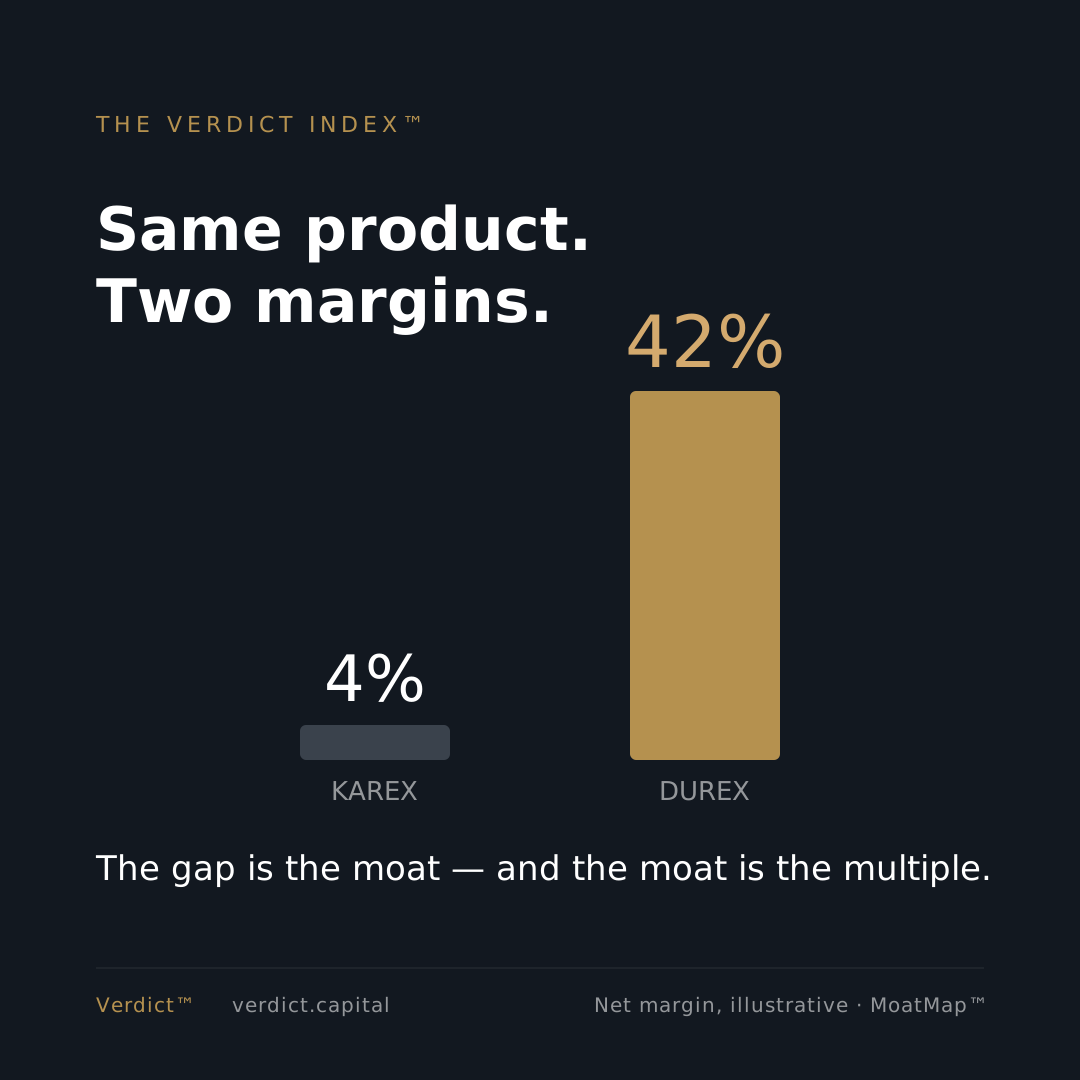
Two companies make the same product. One earns 4% net margin. One earns 42%. The difference is the moat — and it’s the one dimension most founders have never been shown how to measure, because the platforms they use don’t score for it.
~4 min read
Two companies make the same product.
They use the same raw materials. They employ comparable manufacturing processes. They sell into overlapping markets. The product, functionally, is indistinguishable.
One earns approximately 4% net profit margin.
One earns approximately 42%.
The gap between Karex — the world’s largest manufacturer of condoms by volume, based in Malaysia — and Durex — Reckitt’s branded consumer health product — is not a product gap. It is not a manufacturing gap. It is not a market gap.
It is a moat gap.
Karex makes the product. Durex owns the brand. The brand is what consumers reach for. The brand is what retailers allocate shelf space to. The brand is what commands the margin premium. Karex supplies product at commodity margins. Durex captures the value the customer is willing to pay for the feeling of trust, familiarity, and preference that accumulated over decades of brand investment.
The entire gap between 4% and 42% is the moat — the above-commodity margin asset that one company built and one company didn’t.
The lesson
Every founder I have met believes they have a moat. Very few can describe it in a way that investors find convincing.
The reason is definitional. Founders describe competitive advantages — things that differentiate their product today. Investors are looking for something different: durable differentiation — advantages that compound over time, that become harder to replicate as the company grows, that create the conditions for above-commodity margin.
The test is not “can you beat the competition today?” The test is “will you be harder to beat in five years than you are now, and will that hardness to beat show up in your gross margin?”
A product feature is not a moat. Features are replicable. A patent on a feature may be a moat, if the patent is enforceable and the feature is central to the use case. A brand is a moat if customers form genuine preference — not just satisfaction, preference. A network effect is a moat if each additional user makes the product materially more valuable to existing users. A data asset is a moat if it is proprietary and structurally unacquirable by competitors.
Most founders have a competitive advantage. Fewer have a moat. The difference is time, compounding, and margin impact.
The problem nobody solved
The private capital market has, for its entire history, known that moat matters.
It has not had a consistent, comparable way to measure it.
Different investors apply different frameworks. Some focus on network effects. Some on switching costs. Some on brand NPS. Some on gross margin trajectory. The signals are real but they are not aggregated into a single, comparable assessment that a founder can understand, benchmark, and improve against.
This creates a specific problem for founders: they receive moat feedback only after the investor has already passed on the deal. The signal comes as a rejection — “we weren’t convinced by the moat story” — with no specifics, no benchmarks, and no path forward.
The Karex scenario is not hypothetical. It is what happens to every B2B SaaS company that competes on product features with no switching cost, every marketplace that competes on supply density with no preference formation, every services business that competes on quality with no documented differentiation that survives the founder’s departure.
4% net margin. Commodity pricing. No strategic acquirer premium. The company is real, the revenue is real, the team is real — and the company is worth a small multiple of EBITDA because it has no above-commodity margin asset that justifies a premium.
What we built
Verdict™’s Moat dimension scores for durable differentiation across the specific vectors that produce above-commodity margin: switching cost mechanics, network effects, data asset depth, brand preference indicators, and competitive barrier analysis. Not as a single gut-check “how defensible is this?” question — as a structured assessment against the same framework investors apply in due diligence.
The score is directional, not definitive. It tells a founder where they are, against what benchmark, with what gap to close. It is a starting point for the conversation — not a substitute for it.
The ODDS Memo™ integrates the Moat dimension with the other 11 PitchScore™ signals into a daily read of what the odds are that this company raises capital at this stage, from this mandate. It is the answer to the question every founder is actually asking but no one gives them a straight answer to: “What does an investor actually see when they look at my company?”
Verdict Insight™ is where the story lives — the narrative that translates the moat evidence into the language investors use. Verdict Equip™ is where the execution lives — the operational steps that close the gap between the moat you have and the moat the ODDS Score™ requires. ODDS Memo™ is the daily verdict: how capital scores you, and what changes the score.
The close
The Karex-Durex gap is not a Southeast Asia story. It is not a manufacturing story.
It is the same story that plays out in every category, at every stage, across every geography where a commodity producer and a branded player compete for the same customer.
The gap is always the moat. The moat is always the margin. The margin is always the valuation.
Every founder building today is somewhere on the spectrum between Karex and Durex. The ones who know where they are can do something about it. The ones who don’t find out at the term sheet, when the investor offers a 4× revenue multiple instead of the 12× they were expecting, and nobody explains why.
Now you know why.