FounderBrand · Article 1 of 6 · By Siong Yoong
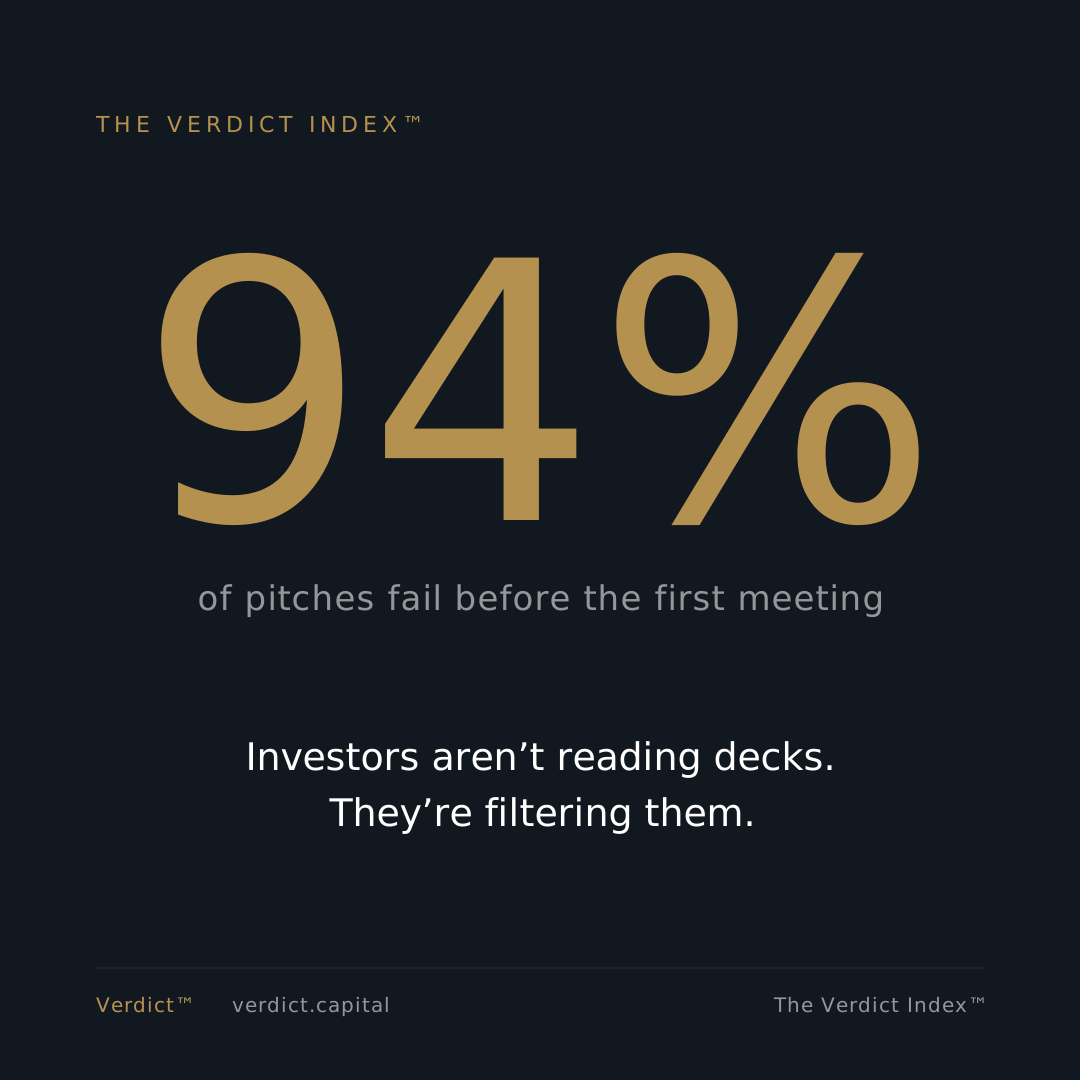
Why 94% of pitches fail before the first meeting
Investors aren’t reading pitch decks. They’re filtering them on a set of signals most founders have never been shown — and the platforms that tell you how many investors opened your deck don’t tell you which signal killed it. That gap between analytics and diagnosis is where most raises end.
~6 min read
The first time I sat in a VC’s chair reading cold decks, I understood something that no founder had ever told me: the problem is not the ideas.
The ideas are fine. Mostly better than fine.
The problem is that investors are not reading pitch decks. They are filtering them.
And the filter runs on a set of signals that most founders have never been told about, because the people who know them don’t usually write about it. They just quietly move on to the next deck.
I have sat on both sides of this conversation since 2007 — 19 years as of 2026. Building companies. Advising them. Sitting across tables in Singapore, London, New York, and Kuala Lumpur while billions of dollars changed hands or didn’t.
Here is what I know.
The 30-second filter
An angel investor or early-stage VC reading 200 decks a month has approximately 30 seconds per deck before they make a binary decision: keep or bin.
That’s not cynicism. That’s arithmetic.
DocSend, which hosts and tracks the decks founders send, puts cold-deck-to-meeting conversion in the low single digits — meaning roughly 94–97% of cold decks never reach a first meeting. Decks arriving by warm introduction convert closer to half (DocSend Startup Index, as of 2026).
In those 30 seconds, they are not evaluating your business. They are running four questions simultaneously, almost always subconsciously:
- Do I understand what this does?
- Do I understand how big this could be?
- Do I understand why this team?
- Is there a reason for me to act now rather than wait?
If the answers to all four are not immediately obvious — not legible in 30 seconds — the deck goes in the bin. Not because the investor is lazy. Because they have 196 more decks to read this week.
The deck that fails is almost never a bad business.
It is a business that was not packaged for this reader, at this moment, in this 30 seconds.
The three signals that get a deck to the next conversation
I’ve reviewed thousands of pitch decks. The ones that convert share three characteristics that have nothing to do with the quality of the underlying business:
1. The Ask is on slide 1.
Not slide 9. Not the appendix. Not “we can discuss terms.” Slide 1.
“We are raising $1.5M at a $9M pre-money valuation to complete our Series Pre-Seed round.”
That’s it. That sentence on slide 1 tells the investor three things immediately: how serious you are, how you think about your valuation, and whether the round size fits their cheque size. Investors who know your ask before they read the deck read it as evidence for a decision, not an evaluation of whether to engage.
Founders hide their ask because they’re worried about anchoring negotiations. This is backwards. The deck is not a negotiation — it’s a first impression. The ask is the first thing they want to know.
2. The problem is quantified, not described.
“Founders waste time on fundraising” is not a problem I can invest in.
“$47,000 of average founder time is lost per raise on unmatched investor outreach” is a problem I can invest in.
The difference is specificity. A specific, quantified problem is falsifiable — which means it’s real. A generic problem is just vibes.
And falsifiability matters because investors are allocating scarce capital against a probability-weighted future. A specific problem with a documented size is a much more investable proposition than a general observation about an industry being “inefficient.”
The entrepreneurs I have watched build real businesses can tell you, in one sentence, who their customer is, what specifically it costs them to have this problem, and why they haven’t solved it yet. That sentence usually took them two years to write.
3. The exit is implicit.
Every investor asks one question that most founders never answer directly: who will buy this business, and when?
It doesn’t appear in the deck as a polite “exit strategy” slide at the back. It’s the first question — asked in the first meeting, sometimes in the first minute. Because that’s how investors evaluate returns.
If your deck has no signal about who the natural acquirer is — no named acquirer category, no above-commodity margin asset, no reason a large corporation would pay a premium to own this — investors fill in the blank themselves. Usually with “nobody.”
Decades of exit research are unambiguous: investors evaluate a business as an exit opportunity from the first meeting. Your competitive slide is an exit signal. Your cap table is an exit signal. Your gross margin is an exit signal. Every number tells the investor whether this business is structurally acquirable.
Most founders think about exit strategy as something they’ll figure out in Year 5. Investors think about it in Year 0. That gap is where most of the 94% live.
Why warm intros don’t solve this
The standard advice for fixing the 94% problem is “get a warm intro.”
This advice is correct and it’s also useless.
It’s correct because deals with warm intros do convert at a higher rate. It’s useless because most of the founders who need it don’t have access to the network required to get one.
The warm intro system is self-reinforcing. The founders who get warm intros are the ones who already have access to investors — through elite universities, former employers, or geographic proximity to the VC ecosystem. Everyone else pitches cold, at a structural disadvantage, with no feedback.
I have watched exceptional founders from Malaysia, Indonesia, Vietnam, and the Philippines — builders with real traction, genuine IP, and credible teams — waste their best years burning through capital and reputation chasing investors who were never going to write a cheque, because no one told them the rules.
That is the dysfunction this platform was built to fix.
What “getting found” actually means
Verdict™ was not built to help founders get meetings.
It was built to help founders become the kind of company that investors are already looking for.
The distinction matters.
A warm intro gets you a meeting. Being the right company at the right stage with the right team gets you a term sheet.
Most pitch coaching focuses on the meeting: how to present, how to handle objections, how to close. That’s backwards. The meeting is already too late for most of the work. The signals that determine whether an investor pays attention to you were set months before the meeting happened.
The PitchScore™ dimension that kills the most deals at Stage 3 is not the business model. It’s not the team. It’s the Moat dimension — specifically, the failure to directly neutralise the most obvious investor objection about your space.
Every sector has one dominant player or one obvious objection. The investor in your category has already heard that objection fifty times from other founders who failed to address it convincingly. If your deck doesn’t neutralise it on slide 8, they stop reading on slide 8. The rest of the deck — which might be exceptional — never gets read.
That’s not a presentation problem. That’s a preparation problem. And preparation is the only part of this equation that’s fully under a founder’s control.
The honest version of the pitch advice you haven’t heard
The reason most decks fail has nothing to do with the quality of your business.
It has everything to do with whether the right investor, with the right mandate, saw it at the right moment, and understood in 30 seconds what you were doing and why they should care.
That’s a matching problem, not a quality problem.
And it is a solvable problem — but only if you stop trying to solve it with the same tools that created it (cold outreach, spray-and-pray investor lists, pitch competitions, warm intro networks you don’t have access to).
The founders I’ve watched raise successfully share one characteristic: they stopped trying to convince investors and started becoming the company that investors had already decided they wanted.
That means doing the boring work. Scoring your own deck honestly. Finding out which dimensions are below the threshold before the investor finds out for you. Fixing the thing that’s killing your match rate before you spend another dollar on outreach.
Three actions before your next investor conversation
- Put your ask on slide 1. Round size, instrument, valuation. Not “we can discuss.” The exact number.
- Write the problem in one falsifiable sentence. If you cannot dispute it with a data point, it’s too vague. Try again.
- Answer the buyer question. Name the category of company that would acquire you. Name what you have that they cannot build in time. That’s your above-commodity margin asset. It belongs in your deck.
These three things won’t guarantee you a yes. Nothing does.
But they will guarantee you are no longer one of the 94%.