Verdict Index™
Half of seeded startups will never raise a Series A — and that’s by design
The wait from seed to Series A has roughly doubled, and the graduation rate has roughly halved. Founders read that as a closed market. It’s the opposite — capital got better at telling proof from noise, and founders who know which signals they’re failing can close the gap before the room decides.
~7 min read · Sources: Carta, DocSend
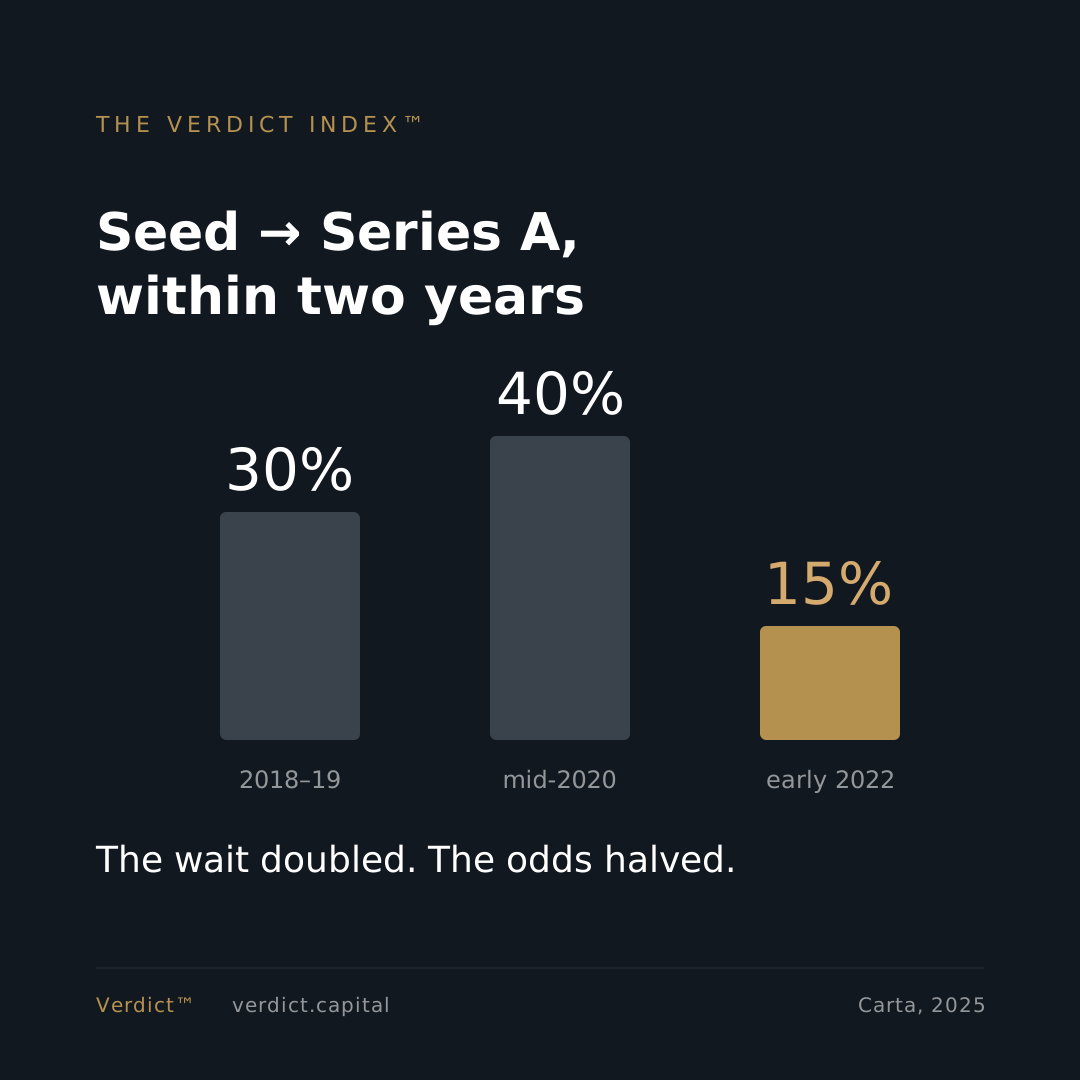
The Series A gap is the widest it has ever been, and that is good news for any founder who can prove something. The median time from seed to Series A now stretches past two years — longer than at any point Carta has measured (Carta, State of Private Markets, 2025). Pair that with the graduation data and the picture sharpens: of companies that raised seed in early 2022, only about 15% had reached a Series A within two years, against roughly 30% for the 2018–2019 cohorts and around 40% for the cohort that raised in mid-2020 (Carta). The wait doubled. The odds halved.
Read that as a market verdict on founders and you reach for the wrong fix. You start optimising for the raise — the deck polish, the warm-intro scramble, the timing of the announcement — when the market has quietly changed what it’s filtering for.
The data
Three numbers tell the whole story.
First, duration. Seed-to-Series A is now measured in multiple years at median. The data is consistent across sources: this is not a temporary tightening, it is a structural shift in what Series A investors require before committing.
Second, graduation. Approximately 15% of companies that raised seed in early 2022 had reached Series A within two years. For 2018–2019 cohorts that number was around 30%. For companies that raised seed in mid-2020, it was around 40%. The collapse is cohort-specific and timing-dependent.
Third, the planning consequence. A seed round sized for an 18-month runway against a 24-plus-month graduation timeline runs dry exactly as proof lands. The company that would have raised Series A in 2022 is now raising a bridge in 2024 from a position of structural weakness rather than demonstrated strength.
The pattern beneath it
The graduation rate did not collapse only because investors got stingier. It collapsed partly because the seed rung got crowded. The 2021 vintage pulled thousands of companies onto the institutional seed rung that would not normally have raised institutional seed. Filtering moved downstream. Series A became the place where the sorting actually happened.
What this means in practice: the bar at Series A did not simply rise. It changed shape. Consider two companies:
Company A raised seed two years ago and has $450,000 ARR. Customer acquisition cost is rising. Churn is running at 8% monthly. There is no documented sales motion — the founder closed the first eight customers personally through their network.
Company B raised seed two years ago and has $350,000 ARR. Net revenue retention is 115%. CAC payback is under 12 months. There is a documented outbound sales process with four steps and a conversion rate at each stage.
Company B will raise Series A. Company A, with higher revenue, will not. The market is not measuring the revenue. It is measuring the proof that the revenue is real, repeatable, and scalable beyond the founder’s personal network.
What to do about it
Three moves that change the outcome:
One: Reverse-engineer the Series A bar for your sector in numbers, now. Not a general idea of what Series A investors want — the specific metrics they use to evaluate companies in your category. For B2B SaaS, that typically means ARR, NRR, CAC payback, and a documented sales motion. For marketplace businesses, it means take rate, liquidity, and repeat transaction rate. Name the numbers. Measure them today. Know the gap.
Two: Pick two or three numbers to make undeniable, and starve everything else. The companies that graduate to Series A in the current environment are not those that performed adequately across ten metrics. They are the ones that made two or three metrics impossible to argue with. Identify which numbers Series A investors in your category care about most. Build everything around improving those numbers. Be deliberately mediocre at the rest.
Three: Time the raise to the proof, not the calendar. Start the fundraising process six months before the company runs out of cash, not six months after you hit the number you thought was the threshold. A matched process — approaching investors who specifically fund companies at your stage, in your sector, with your metrics — will consistently outperform the spray-and-pray approach of contacting every investor on a list. Most outreach tools are optimising for the spray side of that equation — more contacts, faster cadences, AI-personalised cold emails. They make the 66-investor problem more efficient while leaving the 38-meeting problem untouched. The conversion rate does not move because the constraint has never been reach. It has been whether you cleared the mandate filter before the investor saw your name.
The corollary: proof built in the gap compounds. The company that spends the 24 months between seed and Series A building genuine proof — documented sales motion, improving retention, a replicable playbook — does not just raise the Series A. It raises it from a position that sets the slope for every round after.
The bridge round is where startups die quietly. A founder who reaches 18 months with genuine traction but an empty bank account has three bad choices: raise a bridge at punishing terms, sell from weakness, or close. The company that would have raised Series A on merit becomes a funding casualty — not because the product failed, but because the runway ran out before the proof compounded enough to convert the right investor. Fundraising is not a sprint you run when cash gets low. It is a standing function that runs on a rolling 18-to-24-month horizon, because the raise itself consumes 13 to 24 weeks when it works (DocSend, Annual Seed Report, 2023) and considerably longer when the wrong investors are in the room.
The discipline that avoids this outcome is dual: runway management on one side, sustained legibility on the other. Every revenue milestone verified through PathProven MRR™ updates your Verdict™ profile automatically — matched investors see current traction, not the snapshot from the day you first submitted your deck. You do not have to re-pitch to stay visible. The founders who avoid the funding casualty outcome are not the ones who raise fastest. They are the ones who never disappear from the investors who already fit.
The Verdict™ read
A market that takes two years to say yes and turns away five of every six is not a worse market. It is a market that has finally started paying for proof instead of paying for hype. The gap between founders who have genuine proof and investors who are looking for exactly that has never been smaller. The gap between founders who are performing proof and investors who have learned to spot the difference has never been larger.
The Series A didn’t get harder to raise. It got harder to fake. Spend the gap making yourself impossible to argue with.
Sources
- Carta — State of Private Markets: 2025 in Review: carta.com/data/state-of-private-markets-q4-2025/
- Carta — Seed-to-Series A graduation by cohort via SaaStr: saastr.com and Konvoy VC: konvoy.vc
- DocSend — Annual Seed Report, 7 December 2023 (average investors contacted 66 in 2023 vs 48 in 2022; average meetings set 38 vs 56; 50% of successful raises took 13–24 weeks): DocSend Annual Seed Report announcement